 |
| Remittances have become a major source of foreign exchange for The Gambia (Photo by Mass Njie | TNBES | August 13, 2019) |
Showing posts with label Agriculture. Show all posts
Showing posts with label Agriculture. Show all posts
Monday, January 13, 2025
Gambia’s Record Remittances Make up Over a Third of GDP


Thursday, September 13, 2018
Gambian Guild Joins Global Agric Journalists Federation
 |
| NAC, DFAJ trainers and community radio journalists at the launch of a 19-month training on agriculture reporting, Nov. 2015 (Photo Credit: Dawda Bayo) |
Wednesday, March 14, 2018
Gambia, Senegal Implement Agreement to Strengthen Bilateral Interests
 |
| Sall and Barrow speaking to the press in Banjul, Tuesday (photo credit: Omar Wally) |
The meeting, held from March 11-13, 2018 in
Banjul, focused on bilateral issues of common interest.
It was preceded by talks between the Gambian
President Adama Barrow and his Senegalese counterpart Macky Sall.
The Presidential Council (of experts and ministers) was set up by a joint
communique between the two countries in March 2017 at the visit of the Gambian
president to Senegal.
It would
meet every six months, alternatively, in The Gambia and Senegal, under the
joint chairmanship of the two heads of state.
The meeting, attended by officials of the two governments,
examined all issues of bilateral interest.
Officials of the two countries said the biannual meeting
would provide guidance to the two governments for deepening cooperation.
Decisions reached by the Council are to be implemented by the
Senegalo-Gambian Permanent Committee, which is co-chaired by the Vice-President
of The Gambia and the Prime Minister of Senegal.
Monday, June 5, 2017
One tractor is increasing agricultural production and yield in 27 villages
 |
| The multiple roles the tractor plays make it a lucrative investment. They use it for tilling the ground, transporting sand and stones for housing (Photo taken from Sunu Rew shows a tractor parked at Bansang Hospital) |
Monday, May 29, 2017
Causeway increases rice production by two folds
 |
Mr. Banjul Yaffa,
a Contact Farmer showing previously inaccessible land at the Masembe rice fields to a regional agricultural director and an agriculture expert (Photo Credit: MSJoof/TNBES)
|
Monday, May 22, 2017
GYIN Gambia ELIT 2017: Expanding Youth Development Through Entrepreneurial Mentorship
 |
| ELIT 2016 participants pose for an opening photo in Jenoi, Lower River Region (Photo Credit: Modou S. Joof/GYIN Gambia/July 2016) |
Saturday, April 8, 2017
South Africa: Agric, Culture, People and the Sky
 |
|
South
Africa is a water scarce country where only 12 per cent of land can be used for
crop production, but it is Africa’s largest producer and the only net exporter
of food on the continent, says Nico van Burick, chairperson of the Local
Organising Committee for the 2017 IFAJ World Congress. In this
photo, Vito Rugani (center) displays carrots to a visiting team of IFAJ
delegates at his carrot packaging and juice factory in the Gauteng region. He
moved from rags to riches in 20 years and used to sleep on the floor at an
apartment in Johannesburg in the early 1990s. Today, Rugani and his partner,
Vincent Sequeira, produces 40% of South Africa's carrots (Photo Credit:
M.S.Joof/TNBES/April 4) |
Sunday, April 2, 2017
Africa Forum: Journalists Find Solutions to Challenges Facing Agric Journalism
 |
|
One of the most important tools we can use
to improve agriculture is to invest in young people - IFAJ President Owen Roberts (Photo Credit: M.S.Joof/TNBES/April 2).
|
58th IFAJ Congress: Networking among most valued aspects of membership
 |
| Chairperson of LOC says networking top of the list at 2017 IFAJ world congress. Photo shows agriculture journalists from Danmark and Gambia (Photo Credit: Tom Bricknell/Australia) |
Friday, March 31, 2017
South Africa: Economy needs to grow fast to absorb 26 million job seekers
 |
| South Africa, an economy in dilemma (Photo Credit: M.S.Joof/TNBES/March 2017) |
Thursday, March 30, 2017
Award-winning Gambian Journalist Attends 2017 Master Class in South Africa
 |
| Joof interviewing a rice farmer in Salikenni, North Bank Region (Photo Credit: Mamadou Edrisa Njie/Facebook/March 2017) |
Wednesday, February 22, 2017
Gambia: Enhancing food security will take national vision, local action
 |
|
More than 170 project staff and beneficiaries taking part in the annual consultative forum
(Photo credit: M.S.Joof/TNBES/Feb 2017)
|
For Gambia to enhance food security,
strategy and implementation must be linked to attain food security and reduce
poverty, the Agriculture Ministry’s permanent secretary Sait Drammeh said.
Monday, November 14, 2016
P2RS Training Rural Youth to Become Self-Reliant
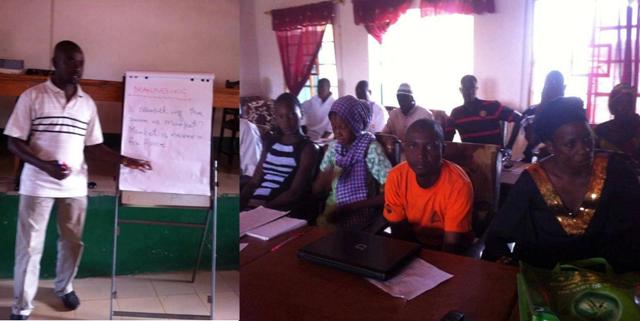 |
| Undertaking
perilous journeys to Europe via deserts and high seas has been the thought of
many young Gambians (male and female) – who often cite the “lack
of opportunities” at home. (Photo Credit: M.E.Njie) |
Monday, October 31, 2016
Alarm Bell Ringing For Women, Youth to Develop Bankable Business Plans – Agric Director
 |
The organisers said the aim of the training is to build the entrepreneurial skills of women and young people to reduce the dependency rate and to eradicate irregular migration to Europe.
|
Monday, February 29, 2016
Brikamaba: Women Turn to Gardens After Failed Rice Growing Season
 |
|
After a failed
rice-growing season, women turn to gardens in Brikamaba, CRR (Photo by M.S.
Joof/TNBES)
|
Some
three hundred and ten women in Brikamaba, Lower Fulladu West of the Central
River Region (CRR) have turned to gardening to fight off food security threats
after a failed rice-growing season.
More
than five hundred women and their families, 282 kilometers from the Gambian
capital, Banjul, saw their rice fields completely destroyed by floods following
torrential rains between July and September in 2015, the villagers told TNBES on Friday.
Tuesday, July 15, 2014

Wednesday, April 30, 2014
Gambia capable of producing million tonnes of rice
 |
RICE as a staple food in Gambia is mainly imported from Asia (Photo credit: Facts and Details) |
The
Gambia has the potential to produce more than two million tonnes of rice
yearly, it’s President and leading farmer, Yahya Jammeh has said.
Two weeks ago,
Jammeh announced his government’s plan to initiate an all-year rice production
scheme that could further efforts to attaining food self-sufficiency. We must feed ourselves, he said of The Gambia, which is endowed with land and fresh
water.
Jammeh had since last year vowed to ban the importation of rice, a staple, into the West African
country by 2016. He is touring the country on his annual ‘meet-the-people-tour’
with an idea of a “Vision 2016 Rice Self-sufficiency Agenda.”
Friday, April 25, 2014
Pres. Jammeh: We must feed ourselves
|
RICE as a staple food in Gambia is mainly imported from Asia (Photo credit: Facts and Details) |
“We must feed
ourselves,” President Yaya Jammeh said of his country, The Gambia, which is
endowed with land and fresh water.
Jammeh has said
his government plans to initiate an all-year round rice production scheme that
could further efforts to attaining food self-sufficiency.
“The
all-year-round rice production would not only ensure that there is enough food
for local consumption, but surplus for export to other countries,” Mr Jammeh
said in the Central River Region according to state media reports.
Wednesday, February 19, 2014
Jammeh to ban import of basic foods ‘without fail’
|
RICE as a staple food in Gambia is mainly imported from Asia (Photo credit: Facts and Details) |
The President of The Gambia has said he is “determined to
end importation of basic food items by 2016 without fail.”
“Our traditional Gambian dishes or foods are being replaced
by unhealthy, and for most Muslims, haram junk food being imported into this
country,” Yahya Jammeh said on the eve of The Gambia’s 49th independence
anniversary of February 18. “This dangerous trend must end.”
In June
2013, President Jammeh announced his government would ban the importation of
rice into the country by 2016.
Saturday, February 1, 2014
The Gambia forcast economic growth at 7.5 per cent
 |
| Projection based on robust expansion of agriculture and tourism, according to Central Bank officials in Gambia. (Photo by Mansa Banko shows officials at a rice field in Central River Region of The Gambia under the Ifad-funded PIWAMP project) |
Subscribe to:
Posts (Atom)